
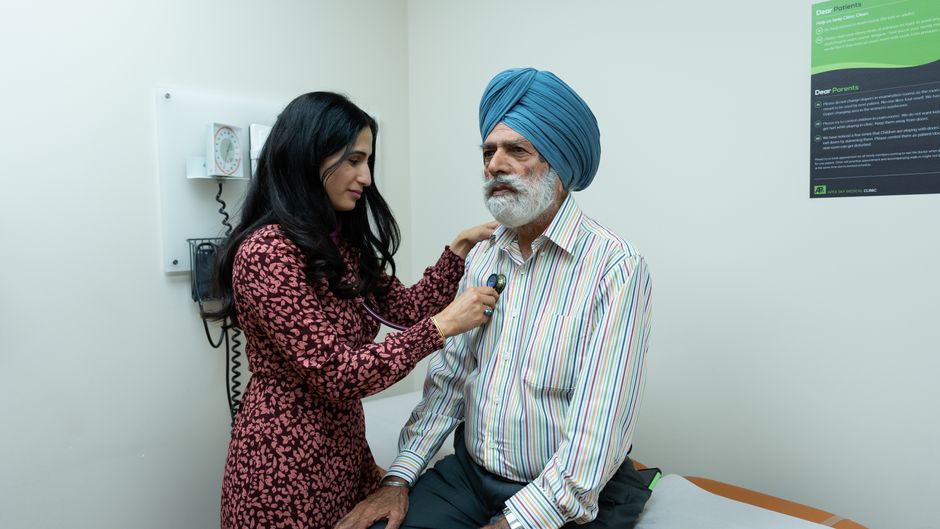
According to the 2024 Working Conditions Balance from TNO (in Dutch), the cost to employers of continued wage payment during work-related sickness absence rose from 5.1 billion euros in 2015 to 8.3 billion euros in 2023. Behind that figure are thousands of employees who drop out ill because of risks that could have been visible much earlier. That is exactly what the periodic occupational health examination, the PAGO, exists for: a statutory instrument that gives you as an employer an early view of the health risks the work brings with it.
Even so, the PAGO is a neglected corner at many organisations. Some employers think a general health check, a lifestyle programme or a broader preventive medical examination is enough. That is a misunderstanding that can cost you dearly. In this article you will read exactly what a PAGO involves, what the law asks of you, how to set the examination up well and how Dokter Beter supports you in it.
What is a periodic occupational health examination?
According to Arboportaal (in Dutch), a PAGO is a focused examination that assesses which health aspects are connected with the risks at the workplace. Think of physical strain, exposure to hazardous substances and psychosocial workload such as work pressure. The aim is twofold: to prevent damage to health and to spot it early when it occurs anyway, even where control measures have already been taken.
The word 'periodic' says a lot here. It is not a one-off snapshot but a recurring examination that moves with the way working conditions develop in your organisation. Exactly how often is not laid down in law. In practice, organisations choose a yearly or two-yearly cycle, depending on how serious the risks on the floor are.
What exactly does the Working Conditions Act say?
Article 18 of the Working Conditions Act (in Dutch) requires every employer to give employees the periodic opportunity to undergo an examination aimed at preventing or limiting, as far as possible, the risks that work brings for health. So the obligation rests with you as the employer: you have to make the offer. The employee is not obliged to take part and may decline.
Besides the general obligation in article 18, the Working Conditions Decree contains additional rules for specific risk groups. For employees working with ionising radiation or under increased pressure, there are even yearly repeat requirements. So it is wise to check whether extra obligations apply in your sector, on top of the standard PAGO.
Do not meet the obligation and the Netherlands Labour Authority can fine you directly. A PAGO is therefore not an optional initiative but a hard statutory requirement that forms part of your wider health and safety policy.
PAGO and RI&E belong together
The content of the periodic occupational health examination is not arbitrary. The examination has no fixed form, but it must always match the risks described in your risk inventory and evaluation (RI&E). If you do not have a current RI&E, you simply do not know what you ought to be examining, and you are in breach before the PAGO even starts.
The reverse holds too: the results of a PAGO can produce new insights that you feed back into the RI&E. That creates a healthy policy cycle in which signals from the floor are structurally turned into improved measures. The NVAB describes this as the health and safety policy cycle (in Dutch): from mapping risks, to taking measures, to monitoring whether those measures really work.
A common mistake: PAGO and a broader medical examination are not the same
In practice the terms PAGO and PMO (preventive medical examination) are often used interchangeably. That leads to a common mistake: employers think that a broader examination or a lifestyle programme already meets their statutory duty. It does not. The revised NVAB guidance on PAGO and PMO (2025) (in Dutch) makes this perfectly clear: a broader examination or lifestyle check may never be used to replace the PAGO.
The difference lies in the focus. The PAGO is aimed solely at work-related health risks flowing from your RI&E. A broader examination looks wider: at general health, lifestyle and employability. Both can exist alongside each other and even reinforce each other, but only the PAGO counts towards the statutory obligation. If you do not monitor the risks from your RI&E through a PAGO, you simply do not meet the Act.
What the physician examines during a PAGO
The content varies by workplace and sector, but a number of themes come back in most PAGOs:
- Physical strain, such as lifting, repetitive movement and awkward working postures
- Exposure to hazardous substances, noise or vibration
- Psychosocial workload, including work pressure, unwanted behaviour and emotional strain
- Screen work and ergonomics
- Night shifts and irregular working hours
The findings lead to concrete advice for both the employer and the individual employee about protective measures. It is always about prevention, never about assessing fitness for work. A PAGO is not an assessment of fitness.
Getting practical: how to set a PAGO up well
Setting up a good periodic occupational health examination calls for a settled approach. Keep the following steps in mind:
- First make sure the RI&E is current: without that basis the PAGO has no content
- Involve the works council or staff representation in the set-up, because the Dutch Works Councils Act applies
- Let the occupational physician determine the content and match it to the specific risks in your organisation
- Make taking part easy for employees and communicate clearly that it is voluntary and confidential
- Translate the collective findings into concrete measures and work them into your health and safety policy
- Plan the examination in a fixed cycle, so that it does not become a one-off action but a structural part of your policy
At Dokter Beter our occupational physicians always match the content of the PAGO to the particular situation in your organisation. We look not only at the letter of the law, but also help you translate the findings into a healthier floor. That way the PAGO does not become a paper obligation but a real instrument for prevention and sustainable employability.
Why spotting things early pays off
Work-related health complaints rarely appear overnight. Back complaints among drivers, hearing damage among welders, burnout complaints among healthcare workers: these are processes that build up over months and sometimes years before someone drops out. Research by TNO and Statistics Netherlands shows that employees with an occupational disease are absent 39 days longer on average than colleagues without one. A PAGO helps recognise and tackle that creeping damage in time, long before dropping out becomes unavoidable.
Health risks at work do not wait until they become visible; a PAGO brings them to the surface before it is too late.
A periodic occupational health examination is more than a statutory obligation. It is a working instrument that helps you as an employer, and your people, recognise and tackle health risks at work in time, before they lead to absence or lasting damage.
Key takeaways
- Offering a PAGO is a statutory obligation for every employer under article 18 of the Working Conditions Act; taking part is voluntary for the employee.
- The content of the PAGO must always be based on the risks from your RI&E; without a current RI&E the substantive basis is missing.
- A broader preventive examination or a lifestyle programme is not a replacement for the PAGO; only the PAGO counts towards the statutory obligation.
- The PAGO is not an assessment of fitness, but a preventive examination aimed at spotting work-related damage to health early.
- The findings of the PAGO feed into your RI&E and your health and safety policy, setting a continuous improvement cycle in motion.
- Involve the works council or staff representation in the set-up of the PAGO; that is required by law.
- A fixed cycle and good communication to employees make the difference between a paper obligation and a genuinely preventive instrument.
Want to know how Dokter Beter could set up or improve a PAGO for your organisation? Get in touch and we will gladly think along about an approach that fits your floor and your risk profile.